Ordering that arrives structured and priced.
The catalogue, the configurator and the pricing engine — the flow that replaces the workbook, from first browse to a submitted order.
Why order forms fail wholesale.
A wholesale order is a negotiation between your catalogue, your rules and that retailer’s terms. Forms and spreadsheets make people do the computing.
When the surcharge table lives in a PDF, every order is an opportunity to forget it. The configurator applies your charges live, every time.
Discount, then VAT, or VAT then discount? Per-size or flat? The engine answers once, in code, identically on every order.
When retailer and studio compute different totals, someone reconciles by email. Server-side pricing means there is only ever one total.
The three parts of the flow.
Each one replaces a piece of the workbook.
Your full collection with photography, per-size trade prices and search — each retailer seeing only their own terms.
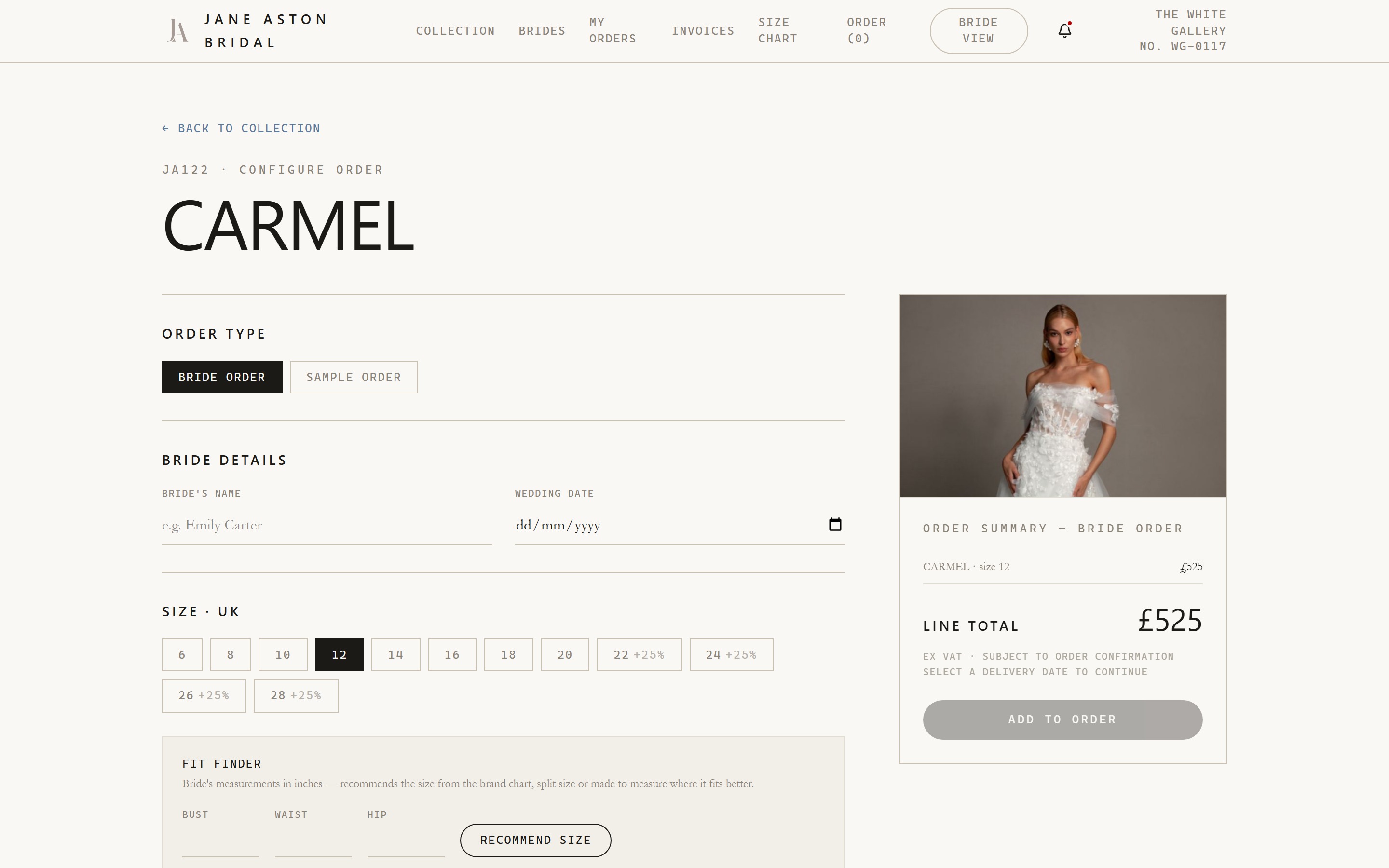
Sizes, colours, split sizing, made-to-measure and every chargeable option — with the line total updating live as the order is built.
Retailers pick a delivery speed from your lead-time bands — or defer for a later date — and every order carries a realistic estimate.
At submission the server recomputes every line from your current price lists — the browser’s arithmetic is never trusted.
The pricing engine is the single source of truth
Every price on the platform — the live total in the configurator, the submitted order, the invoice, the analytics — comes from one engine applying one set of rules: base size price, option charges, size surcharges, the retailer’s trade discount, then their VAT treatment. When a label onboards, the engine’s output is reconciled against their original workbook so the totals agree to the penny before a single stockist signs in.
Change a price in the studio and it takes effect immediately for every retailer’s next order; historic orders keep the prices they were placed at.
Made-to-order without the email thread
Complex products need conversations — the configurator just moves them out of email. Free-text specifications (a custom skirt length, a pattern change note) are captured on the order line and carried through to the order document and the factory spec, so the studio and the maker read the stockist’s exact words, once.
Orders arrive ready for production
A submitted order is structured data: styles, sizes, options, notes, attachments, estimated delivery and a server-computed total on that retailer’s terms. Confirm it and the invoice raises, the factory receives its spec and the order enters the production pipeline — with nobody re-typing anything at any step.
Jane Aston Bridal runs its wholesale on Labels.io — 100+ styles, stockists ordering on her own domain, and a factory connected by email.
Read the case study →Questions, answered.
See it with your own collection.
Book a demo and we'll walk through your catalogue, show you the portal your stockists would use, and give you a firm quote.
Book a demoFor bridal labelsInvoicing & paymentsHow ordering works (docs)