The wedding date runs the schedule.
Made-to-order production with an immovable deadline needs more than a status column. Every order is scored against its date, and everyone sees the same truth.
Deadlines a spreadsheet cannot see.
A status column tells you where an order is. It cannot tell you whether that is good enough for a wedding in nine weeks.
Forty orders “in production” looks fine — until you rank them by wedding date and stage, and two of them are quietly impossible.
If progress is reported by email, your production picture is only as current as the last reply — and your stockists’ picture is worse.
By the time a boutique rings about a gown, the question has usually been askable — and answerable — for weeks.
One risk picture, three audiences.
Studio, stockist and factory each see what they need — computed from the same orders.
Every live order scored on track / watch / at risk / critical from its stage, delivery estimate and wedding date — worst first.
Each order tracked stage by stage in the portal, with notifications on every change and a reassurance line against the wedding.
Price-masked work ranked by nearest ship-by date with urgency flags — plus the emailed spec and no-login acknowledge page.
At-risk and critical orders surface on your dashboard, and a daily digest can email you anything that needs attention.
How the risk score works
Every bride order carries a wedding date; every order carries an estimated delivery from your lead-time bands and its current production stage. The risk engine combines the three: how much runway remains between the stage the gown is at and the date it must be worn. The result is a plain, explainable flag — on track, watch, at risk or critical — with the reason spelt out, not a black-box score.
The factory is inside the loop, not chasing it
When you confirm an order your factory receives the full price-masked spec by email — style, size, every customisation, the gown photo and the stockist’s reference images — with a link to view, print and confirm receipt that needs no account at all. As they advance each gown through cutting, production and quality check, the stockist’s timeline updates and the studio is notified, automatically.
Factories that sign in get a work queue ranked by nearest ship-by date with red, amber and green urgency flags — and a factory sewing for several labels on the platform sees all of them in one consolidated queue.
Not just bridal
Any made-to-order label with event deadlines — occasionwear, eveningwear, prom — gets the same protection: the date drives the ranking, whatever the date is for.
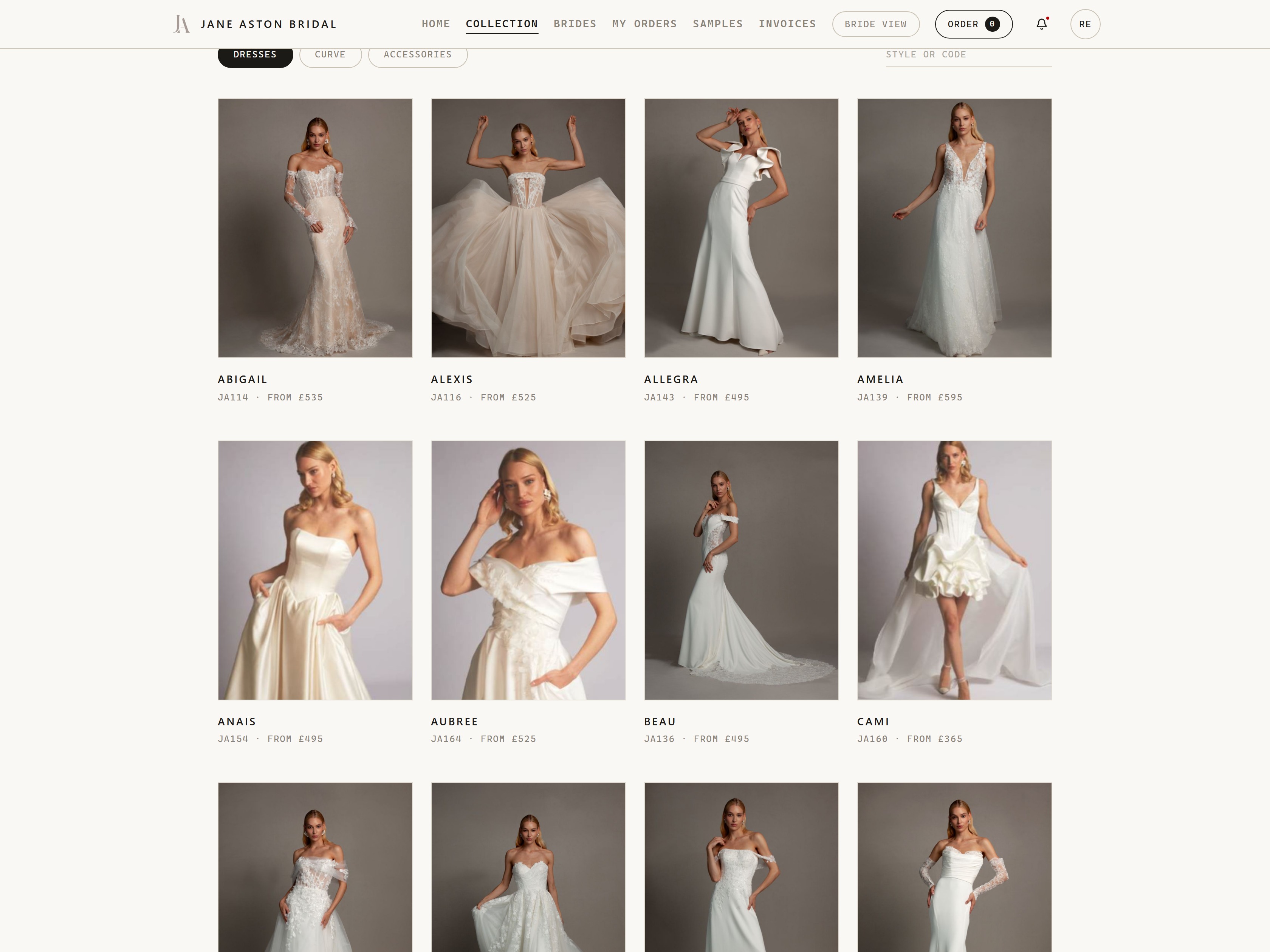
Jane Aston Bridal runs its wholesale on Labels.io — 100+ styles, stockists ordering on her own domain, and a factory connected by email.
Read the case study →Questions, answered.
See it with your own collection.
Book a demo and we'll walk through your catalogue, show you the portal your stockists would use, and give you a firm quote.
Book a demoFor bridal labelsThe factory workflow (blog)Orders & production (docs)