Bridal wholesale, off the spreadsheet.
Your stockists browse the collection, build made-to-order gowns priced to the penny, and track every order against its wedding date — on your domain, in your brand.
Bridal wholesale has the hardest orders in fashion.
A bridal trade order is not a size and a quantity. It carries a bride, a wedding date, a page of customisations and a five-month lead time — and most labels still run all of it through a workbook.
Split sizing, made-to-measure, skirt lengths, lining, boning, colour, closures — one gown can carry a dozen chargeable decisions, each re-keyed by hand today.
The wedding date does not move. A missed dispatch is not a late delivery — it is a bride without a gown, and a stockist you may lose.
Per-size matrices, curve surcharges, option charges, each boutique on its own discount and VAT treatment. One stale price list in one inbox and the totals stop matching.
Built for the way bridal actually trades.
Not a generic B2B cart with a veil on it — the made-to-order mechanics are the core of the platform.
Split sizing, made-to-measure with measurements, custom skirt lengths, pattern changes with notes for the studio — every option priced live from your rules.
Every live order is scored against its wedding date — on track, watch, at risk, critical — with alerts before anything slips.
Your stockists keep each bride’s measurements, fittings and gowns in the portal, so it becomes their daily book — not just your order form.
Confirmed orders reach your maker as a price-masked spec by email, with one tap to acknowledge — wherever in the world they sew.
From line sheet to live portal, without re-typing
Your catalogue almost certainly already exists — as a line sheet, a per-size price workbook and a folder of photography. That is exactly what we import. Styles, codes, size matrices, option charges, colours and bundled accessories come across directly, and the launch data is reconciled against your original workbook so the first order a stockist prices agrees with the spreadsheet it replaced, to the penny.
After launch the catalogue is yours to run: edit styles and prices in the studio, or make season-wide changes by exporting to CSV, editing in your spreadsheet of choice, and importing back with a full diff preview before anything is applied.
The wedding date runs the production schedule
Because every bride order carries a wedding date, the platform can do something a spreadsheet never could: rank your entire work-in-progress by real risk. The production schedule scores every live order against its date and its current stage, surfaces anything at risk on your dashboard, and can email you a daily digest before a problem becomes a phone call.
Your stockists see the same truth from their side — a live timeline for every gown, with a plain-language reassurance line when things are on track and an honest flag when they are tight.
The whole season in one system
Ordering is the start. Confirmed orders raise invoices with each boutique’s deposit and payment terms; sample orders get their own report so you know which shopfloors carry which gowns; and analytics show your best sellers, slow movers and top stockists — with CSV export, because your data is always yours.
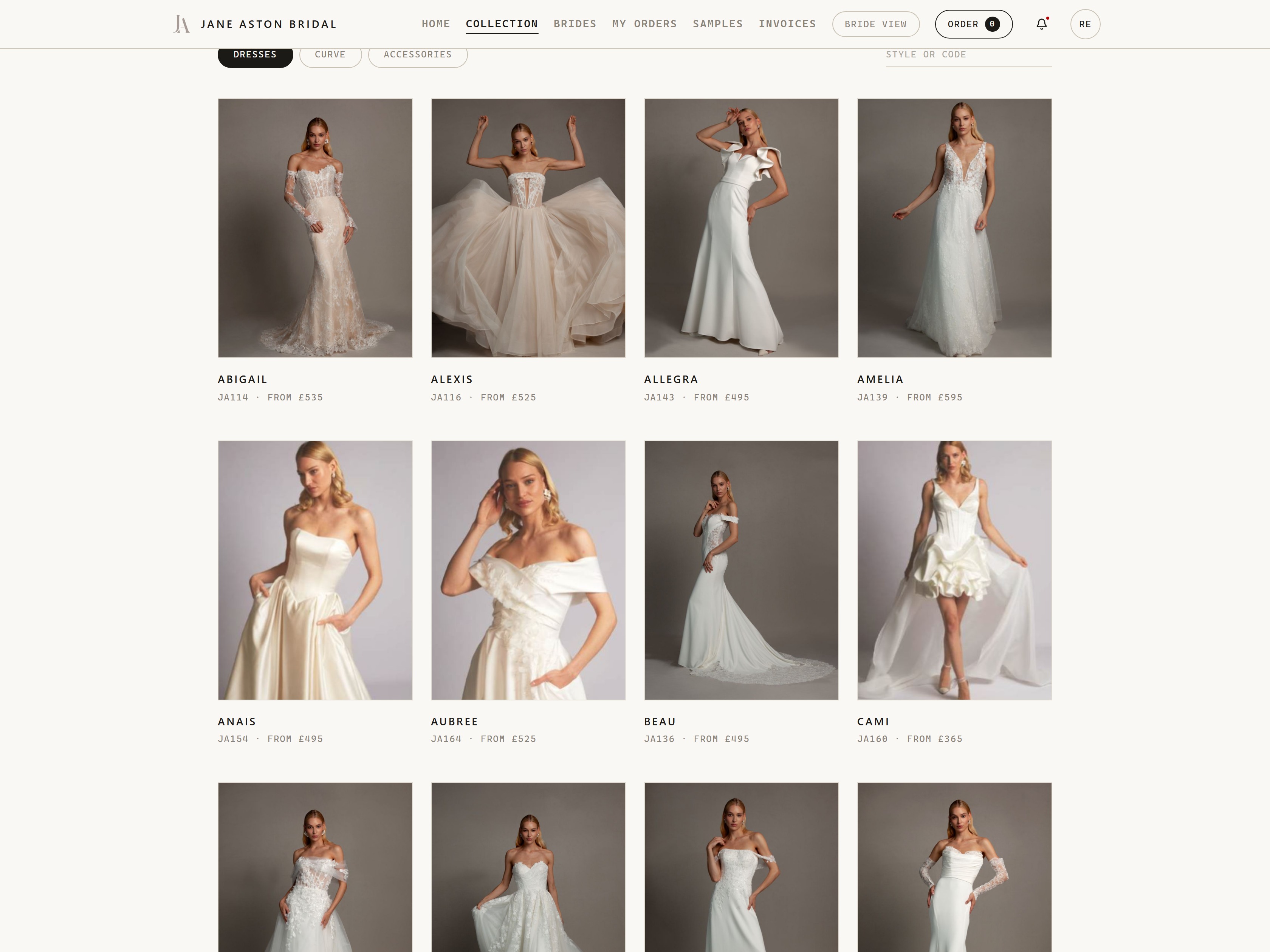
Jane Aston Bridal runs its wholesale on Labels.io — 100+ styles, stockists ordering on her own domain, and a factory connected by email.
Read the case study →Questions, answered.
See it with your own collection.
Book a demo and we'll walk through your catalogue, show you the portal your stockists would use, and give you a firm quote.
Book a demoHow Jane Aston Bridal did itWedding-date protectionThe bride book